
One other person, place or group in the registry answers to the name Ephraim. Every Ephraim in the Bible
person · also Ephraimite · Ephron · Ephrathite
Ephraim
אֶפְרַ֫יִם
- verses
- 159
- first named
- Genesis 41:52
- last named
- Zechariah 10:7
- period
- the Patriarchs
- tribe
- Ephraim
Description
Who was Ephraim?
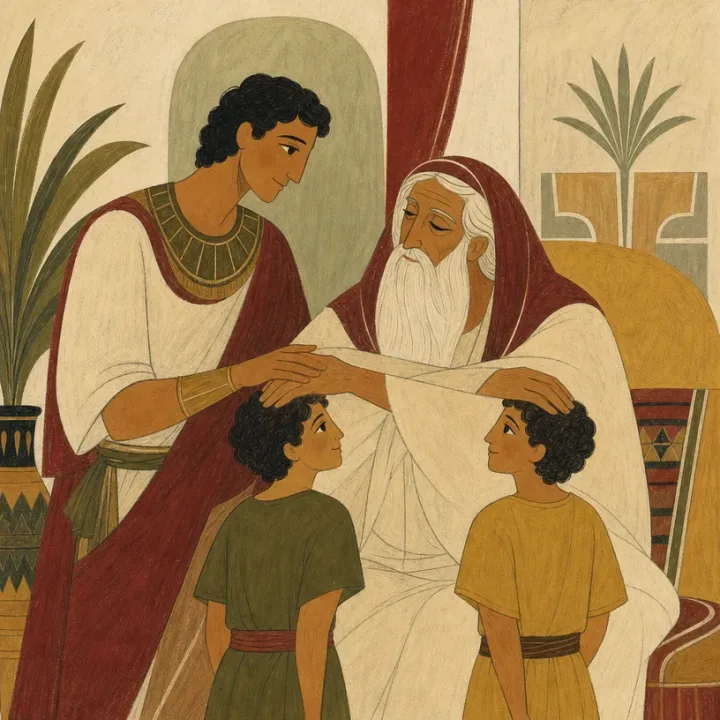
Ephraim was the second son of Joseph, born to him in Egypt by his wife Asenath (Gen.41.52). He and his older brother Manasseh were adopted by Israel (or 'Jacob') and blessed, with Ephraim receiving the greater blessing (Gen.48). Ephraim's descendants formed one of the twelve tribes of Israel, and they were often grouped with the tribe of Manasseh under the collective name "Joseph" (Num.1.32,33; 26.28,35,37).
The tribe of Ephraim settled in the central region of Canaan (Jos.16.4,5,8,9,10) and played a significant role throughout Israel's history. They were known for their military prowess (Jdg.5.14; Psa.78.9) and produced several notable leaders, including Joshua (Num.13.8), Abdon (Jdg.12.15), and Samuel (1Sa.1.1). However, they also exhibited pride and a rebellious spirit at times (Jdg.8.1,2; 12.1; 2Sa.20.21).
Ephraim, along with the other northern tribes, separated from Judah after Solomon's reign and formed the northern kingdom of Israel (1Ki.12.25). The prophets often addressed Ephraim, warning them of judgment for their idolatry and unfaithfulness (Isa.7.2,5,8,9; Jer.31.18,20; Hos.4.17; 5). However, there were also promises of restoration and blessing (Jer.31.6,9; Ezk.37.16,19).
In the New Testament, Ephraim is mentioned in the context of Jesus withdrawing to a village called Ephraim before his final entry into Jerusalem (Jdg.12.6; 1Ch.12.30; 27.20; 2Ch.25.7; Psa.78.9; 2Ch.13.19; 1Ki.11.26; 1Sa.1.1).
Relations
Direct connections
Every entity the graph places in a stated relation with this one, grouped by the kind of link. Each relation is authored once and its inverse derived, so both ends always agree. Rows marked “registry” come from the identity spine rather than from a verse, and a row marked “which bearer is the source’s decision” is one where the name could have meant more than one person. The last group is not a relation at all — it counts the events two entities stand in together.
The 10 best-attested of 35 are drawn. All 35 are listed below.
Ancestor of
Associated with
Child of
- Asenathregistry, no verse
- JosephregistryGenesis 48:1Numbers 1:10Joshua 16:4
Contains
Father of
- Becherregistry, no verse
- Beriahregistry, no verse
- Eleadregistry1 Chronicles 7:22
- Ezerregistry1 Chronicles 7:22
- Shuthelahregistry, no verse
- Tahanregistry, no verse
Parent of
Sibling of
- Manassehregistry, no verse
Site of
Took part in
- Allotment of Levite PasturelandsJoshua 21:20
- Israel’s hand placement of Ephraim and ManassehGenesis 48:14Genesis 48:17
- Joseph AllotmentJoshua 16:4
- Judgment of EphraimHosea 5:11
- Kohathite First LotJoshua 21:5
- LORD’s punishment of Jacob and EphraimHosea 12:14
- LORD’s repayment of JacobHosea 12:14
- LORD’s restoration of IsraelJeremiah 31:18
- Syria, Ephraim, and Pekah’s plot of AhazIsaiah 7:5
Stands in the same events as
- Manasseh21 events
- Judah16 events
- Israel15 events
- LORD14 events
- Benjamin4 events
- Assyria4 events
- Gezer4 events
- Jerusalem3 events
- Joseph3 events
- Hezekiah3 events
- Egypt2 events
- City2 events
and 75 more, ordered by how many events they share.
Places
Where this happens
The places the claims about this person reach, drawn where the gazetteer locates them. A point is where a row puts them and never where tradition does; no line joins two points, because the rows state where and not in what order.
Read it
Where to read it
Every verse of the text carried here that names this entity — 159, across 18 books. The name is written 178 times in them.
Genesis9 verses
Numbers12 verses
Deuteronomy2 verses
Joshua18 verses
14:416:416:516:816:916:1017:817:917:1017:1517:1719:5020:721:521:2021:2124:3024:33
Judges22 verses
1:292:93:274:55:147:248:18:210:110:912:112:412:512:612:1517:117:818:218:1319:119:1619:18
1 Samuel3 verses
2 Samuel2 verses
1 Kings3 verses
2 Kings1 verse
1 Chronicles9 verses
2 Chronicles16 verses
13:413:1915:815:917:219:425:725:1028:728:1230:130:1030:1831:134:634:9
Psalms5 verses
Isaiah11 verses
Jeremiah6 verses
Ezekiel4 verses
Hosea32 verses
4:175:35:55:95:115:125:135:146:46:107:17:87:118:98:119:39:89:119:139:1610:610:1111:311:811:911:1212:112:812:1413:113:1214:8
Obadiah1 verse
Zechariah3 verses
Onward
Where this page goes
Not the direct relations above — these are one hop further out, ranked so that a rare shared connection outweighs a common one. Descriptions by STEPBible TIPNR.
Where they appear
Chapter by chapter
Atlas's reading of each chapter this person appears in, in canonical order. One line per chapter, and each leads to the whole of it.
- Genesis 48Ephraim, the younger son, receives Israel’s right hand and is placed before his elder brother.
- Deuteronomy 33Ephraim is counted among the myriads of the wild ox's horns.
- Joshua 16Ephraim receives his inheritance with the cities, villages, and boundaries assigned to his clans.
- Judges 8Ephraim contended violently with Gideon until he praised their gleanings and recalled their capture of Oreb and Zeeb.
- Judges 12Ephraim assembled, crossed the Jordan, challenged Jephthah, and lost 42,000 men at the fords.
- Judges 19Ephraim is the hill country from which the Levite comes and where the old man is originally from.
- 2 Chronicles 15People from Ephraim settled among Judah and Benjamin and gathered with them.
- 2 Chronicles 19The hill country of Ephraim marked the northern reach of Jehoshaphat’s journey among the people.
20 more chapters, from 2 Chronicles 25 to Zechariah 10
- 2 Chronicles 25Ephraim was named among those with whom the LORD was not going into battle.
- 2 Chronicles 30Ephraim hears the proclamation, though many of its people scorn the couriers, and some come to the feast.
- Psalms 78Ephraim’s archers turned back in battle, and the tribe was later refused.
- Isaiah 7Ephraim joins the threat against Judah and is promised a future shattering as a people.
- Isaiah 9Ephraim turns against Manasseh, then joins Manasseh in turning against Judah.
- Isaiah 11Ephraim’s jealousy departs, and Ephraim joins Judah against their enemies.
- Isaiah 17Ephraim loses its fortress.
- Jeremiah 31Ephraim moaned under discipline, returned, repented, and was remembered by the LORD as a precious and delightful child.
- Ezekiel 37Ephraim appears on one of the two sticks, joined to Judah as part of a people no longer divided.
- Hosea 4Ephraim is joined to idols and is told to be left alone.
- Hosea 5Ephraim turns to prostitution, follows worthless idols, and sends to Assyria for a cure that cannot come.
- Hosea 6Ephraim is charged with vanishing loyalty and prostitution.
- Hosea 7Ephraim mixes with the nations, grows gray without noticing, and calls first to Egypt and then to Assyria.
- Hosea 8Ephraim multiplies altars for sin and hires lovers.
- Hosea 9Ephraim leaves the LORD’s land, loses glory, root, and fruit, and becomes a wanderer among the nations.
- Hosea 10Ephraim, the heifer fond of threshing, was threatened with a yoke and left ashamed of its wooden idols.
- Hosea 11Ephraim was taught to walk, healed, led with kindness, and later accused of lies.
- Hosea 12Ephraim pursues the east wind, makes a covenant with Assyria, sends olive oil to Egypt, boasts of his wealth, and provokes bitter anger.
- Hosea 13Ephraim spoke with such force that Israel trembled, turned to Baal, flourished among his brothers, and failed to present himself at the opening of the womb.
- Zechariah 10Ephraim becomes like a mighty man, with glad hearts and joyful children.
Sources