
3 others in the registry answer to the name Manasseh. Every Manasseh in the Bible
person · also Manassite
Manasseh
מְנַשֶּׁהΜανασσῆς
- verses
- 112
- first named
- Genesis 41:51
- last named
- Revelation 7:6
- period
- the Patriarchs
- tribe
- Manasseh
Description
Who was Manasseh?
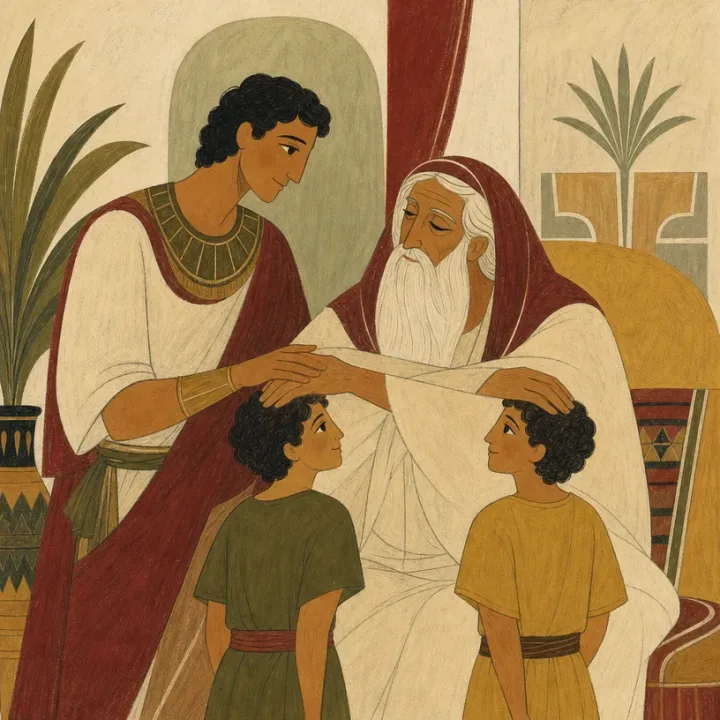
Manasseh was the firstborn son of Joseph and Asenath, born in Egypt before the famine. When Israel (or 'Jacob') blessed Joseph's sons, he gave the greater blessing to Ephraim, the younger son, despite Joseph's objection. The tribe of Manasseh, along with Ephraim, became one of the twelve tribes of Israel.
During the Exodus, the tribe of Manasseh was counted in the census and arranged in the camp under their standard. They had a significant population and contributed to the army. Notable descendants of Manasseh include Gaddi, who was among the twelve spies sent to explore Canaan, and Zelophehad's daughters, who received an inheritance among their uncles due to their father's lack of sons.
When the Promised Land was divided, half of the tribe of Manasseh settled east of the Jordan River, while the other half settled west of the Jordan. The eastern portion of Manasseh, along with Reuben and Gad, assisted in the conquest of Canaan before returning to their inheritance. The western portion of Manasseh received cities and territories, including the city of refuge, Golan.
Throughout Israel's history, the tribe of Manasseh played significant roles. They participated in the conquest of Canaan, fought alongside Gideon against the Midianites, and joined David's army. However, they also faced challenges, such as incomplete conquest of their territories and occasional conflicts with other tribes.
In later prophecies, Manasseh is mentioned as part of the restored Israel. The tribe is also listed among the sealed servants of God in the Book of Revelation.
Manasseh is also used to refer to the territory allotted to the tribe of Manasseh. The tribe's inheritance was divided between the eastern and western portions of the Promised Land.
The eastern portion of Manasseh's territory was conquered by Jair, a descendant of Manasseh, and was named Havvoth-jair. This region was known for its small towns and villages.
The western portion of Manasseh's territory was located in the heart of Canaan. It included cities such as Beth-shean, Ibleam, Dor, En-dor, Taanach, and Megiddo, along with their villages. However, the Manassites were unable to drive out the Canaanites from these cities completely.
Manasseh's territory also included the city of refuge, Golan, in the region of Bashan. This city was designated as a place of asylum for those who unintentionally caused the death of another person.
The territory of Manasseh is mentioned in the context of the conquest of Canaan, the division of the land among the tribes, and the establishment of cities of refuge. It is also noted in the description of the regions that remained loyal to the house of David during the reign of King Pekah of Israel.
Relations
Direct connections
Every entity the graph places in a stated relation with this one, grouped by the kind of link. Each relation is authored once and its inverse derived, so both ends always agree. Rows marked “registry” come from the identity spine rather than from a verse, and a row marked “which bearer is the source’s decision” is one where the name could have meant more than one person. The last group is not a relation at all — it counts the events two entities stand in together.
The 10 best-attested of 35 are drawn. All 35 are listed below.
Ancestor of
Associated with
Child of
- Asenathregistry, no verse
- JosephregistryGenesis 48:1Numbers 1:10Numbers 27:1 +5
Contains
Father of
- Asrielregistry, no verse
- MachirregistryGenesis 50:23Numbers 27:1Numbers 32:39 +5
Parent of
Sibling of
- Ephraimregistry, no verse
Site of
Spouse of
- Aramitessregistry1 Chronicles 7:14
Took part in
- Allotment of Inheritance, Beth-Shean, Ibleam, Dor, En-Dor, Taanach, and MegiddoJoshua 17:1Joshua 17:5Joshua 17:11
- Eleazar and Joshua’s allotment of LandNumbers 34:14
- Giver’s giving of Hill Country GileadDeuteronomy 3:13
- Israel, Moses, and Joshua’s taking of Their Lands, Arabah, Sihon, and OgJoshua 12:6
- Israel’s assignment of Hebron Surrounding Pasturelands, Hebron, Libnah, Jattir, and Eshtemoa1 Chronicles 6:61
- Israel’s hand placement of Ephraim and ManassehGenesis 48:14
- Joseph AllotmentJoshua 16:4
- Kohathite First LotJoshua 21:5
- Manasseh BorderJoshua 17:7Joshua 17:9
- Receiving of Golan, Ashtaroth, Levite Pasturelands, Kishion, Daberath, Gershonite Cities, and Gershonite PasturelandsJoshua 21:6Joshua 21:27
- Tribal SealingRevelation 7:6
- Whole Nation, Reuben, Gad, Manasseh, and Troops’ crossingJoshua 4:12
- You and Moses’ giving of Jazer Gilead RegionNumbers 32:33
Stands in the same events as
- Ephraim21 events
- Israel14 events
- Reuben9 events
- Gad9 events
- Judah7 events
- Asher7 events
- Naphtali6 events
- Jordan5 events
- Issachar5 events
- Moses4 events
- Joseph4 events
- Benjamin4 events
and 85 more, ordered by how many events they share.
Places
Where this happens
The places the claims about this person reach, drawn where the gazetteer locates them. A point is where a row puts them and never where tradition does; no line joins two points, because the rows state where and not in what order.
Read it
Where to read it
Every verse of the text carried here that names this entity — 112, across 13 books. The name is written 124 times in them.
Genesis9 verses
Numbers19 verses
1:101:341:352:207:5410:2313:1126:2826:2926:3427:132:3332:3932:4032:4134:1434:2336:136:12
Deuteronomy6 verses
Joshua37 verses
1:124:1212:613:713:2913:3114:416:416:917:117:217:317:517:617:717:817:917:1017:1117:1217:1718:720:821:521:621:2521:2722:122:722:922:1022:1122:1322:1522:2122:3022:31
Judges6 verses
1 Kings1 verse
2 Kings1 verse
1 Chronicles18 verses
5:185:235:266:616:626:706:717:147:177:299:312:1912:2012:3112:3726:3227:2027:21
2 Chronicles8 verses
Psalms3 verses
Isaiah1 verse
Ezekiel2 verses
Revelation1 verse
Onward
Where this page goes
Not the direct relations above — these are one hop further out, ranked so that a rare shared connection outweighs a common one. Descriptions by STEPBible TIPNR.
Where they appear
Chapter by chapter
Atlas's reading of each chapter this person appears in, in canonical order. One line per chapter, and each leads to the whole of it.
- Genesis 41Manasseh is born to Joseph and Asenath and receives his name from Joseph’s remembrance of hardship and his father’s household.
- Genesis 48Manasseh stands as the firstborn, receives the left hand, and is promised that he too will become a great people.
- Numbers 32Manasseh received half a share of the eastern kingdoms, while descendants of Machir and Jair captured and settled territory there.
- Numbers 34Manasseh is represented among the leaders by Hanniel and has already received an inheritance with the half-tribe.
- Numbers 36Manasseh receives the marriages and keeps the inheritance of Zelophehad’s daughters within their father’s clan.
- Joshua 4The half-tribe of Manasseh crosses before Israel, armed for battle as Moses had instructed.
- Joshua 13Manasseh received land east of the Jordan, with half the tribe taking Bashan and the kingdom of Og.
- Joshua 17Manasseh receives ten shares, Gilead, Bashan, and cities it cannot fully occupy.
10 more chapters, from Joshua 20 to Revelation 7
- Joshua 20Manasseh supplied Golan in Bashan as a city of refuge.
- Joshua 22The half-tribe of Manasseh helped build the altar and explain it as a witness between the generations.
- Judges 6Manasseh receives Gideon’s summons and comes up to meet him.
- Judges 7Manasseh was called out with the pursuing men of Israel.
- Judges 11Manasseh was passed through as Jephthah advanced toward the Ammonites.
- 1 Chronicles 12Men of Manasseh accompanied David toward battle with the Philistines, were sent away by the Philistine rulers, and then helped David against raiders.
- 2 Chronicles 15People from Manasseh settled among Judah and Benjamin and gathered with them.
- 2 Chronicles 30Manasseh receives the invitation, is mocked by some, and sends humbled people to Jerusalem.
- Isaiah 9Manasseh devours Ephraim and then turns with Ephraim against Judah.
- Revelation 7Manasseh is counted among the tribes, with 12,000 sealed.
Sources