
place · also Philistine
Philistia
פְּלֶ֫שֶׁת
The Philistines were a powerful people who inhabited the coastal plain of Canaan and were often in conflict with the Israelites during the period of the judges and early monarchy.
- verses
- 250
- first named
- Genesis 21:32
- last named
- Zechariah 9:7
- feature
- region
Description
Philistia in the text
The Philistines were an ancient people who lived in the coastal plain of Canaan, primarily in the region known as Philistia, which corresponds to the modern-day Gaza Strip and the southern coast of Israel. They are first mentioned in the Bible during the time of Abraham (Gen. 21:32, 34) and Isaac (Gen. 26:1, 8, 14-15, 18). The Philistines were not part of the original inhabitants of Canaan and are believed to have migrated from the Aegean region, possibly as part of the Sea Peoples' movement in the 12th century BC.
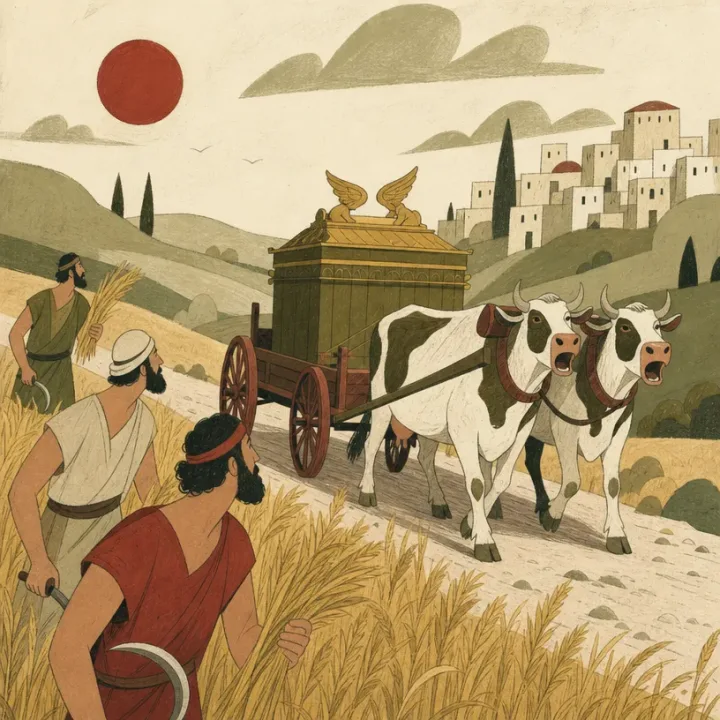
Throughout the period of the judges and the early monarchy, the Philistines were a constant threat to the Israelites. They oppressed Israel for 40 years until Samson began to deliver them (Judg. 13:1, 5). Samson's encounters with the Philistines, including his marriage to a Philistine woman and his final act of bringing down the temple of Dagon, are recorded in Judges 14-16. During the time of Samuel, the Philistines defeated Israel and captured the Ark of the Covenant (1Sam. 4). They were later forced to return the Ark after experiencing plagues (1Sam. 5-6).
The Philistines continued to be a significant enemy during the reigns of Saul and David. The famous battle between David and the Philistine giant Goliath took place during this time (1Sam. 17). David fought against the Philistines throughout his reign (2Sam. 5; 8:1, 12; 21; 23), and they remained a threat until the later years of the divided monarchy (2Kgs. 18:8; 2Chr. 26:6-7; 28:18). The prophets Isaiah, Jeremiah, Ezekiel, Amos, and Zephaniah all mention the Philistines in their oracles, often pronouncing judgment against them (Isa. 14:29-31; Jer. 47; Ezek. 25:15-17; Amo.1.8; Zeph. 2:5).
The Philistines were known for their advanced iron technology, their distinctive pottery, and their religious practices, which included the worship of deities such as Dagon, Ashtoreth, and Baal-Zebub. The biblical narrative portrays them as a formidable enemy of Israel, but also as a people whom God used to test and discipline His chosen nation.
Relations
Direct connections
Every entity the graph places in a stated relation with this one, grouped by the kind of link. Each relation is authored once and its inverse derived, so both ends always agree. Rows marked “registry” come from the identity spine rather than from a verse, and a row marked “which bearer is the source’s decision” is one where the name could have meant more than one person. The last group is not a relation at all — it counts the events two entities stand in together.
Associated with
Site of
Took part in
- David And His Men’s attack of Philistia1 Chronicles 14:141 Chronicles 14:16
- David’s dedication2 Samuel 8:12
- David’s going and fighting of Philistia1 Samuel 17:321 Samuel 17:55
- David’s killing of Goliath1 Samuel 17:50
- David’s striking down of Goliath1 Samuel 17:50
- Delivery of Men Of The Outpost1 Samuel 14:10
- Get Woman As WifeJudges 14:3
- Goliath and Philistia’s standing1 Samuel 17:16
- Help of Uzziah, Philistia, Arabia, and Meunites2 Chronicles 26:7
- Jeiel and Maaseiah’s war of Philistia2 Chronicles 26:6
- Jonathan and Young Man Bearing His Armor’s showing of Philistia1 Samuel 14:8
- Judah Men’s goingJudges 15:12
- Men and Israel’s fleeing1 Samuel 4:17
- Men Of Israel and Philistia’s death of Jonathan, Abinadab, Malchi-Shua, Saul, and Saul Three Sons1 Samuel 31:2
- Men Of Israel’s slaughter of Philistia1 Samuel 14:301 Samuel 14:31
- Philistia and Rulers Of Philistines’ transport of Ark Of God1 Samuel 5:1
- Philistia and Saul’s warfare of Israel and Saul1 Samuel 28:11 Samuel 28:41 Samuel 28:15
- Philistia’s assembly of Israel1 Samuel 13:51 Samuel 13:11
- Philistia’s battle of Israel1 Samuel 4:11 Samuel 4:10
- Philistia’s battle of Saul1 Chronicles 10:1
- Philistia’s camping1 Samuel 13:51 Samuel 13:16
- Philistia’s return of Ark Of The Lord1 Samuel 6:31 Samuel 6:21
- Saul and Chosen Men’s pursuit of Philistia, David, and Davids Men1 Samuel 24:1
- Saul, Men Of Israel, Israel, and Philistine Forces’ battle preparation of Philistia1 Samuel 17:2
- Saul’s fighting1 Samuel 14:47
- Solomon’s reign — first named at 1 Kings 4:211 Kings 4:21
- Solomon’s reign — first named at 2 Chronicles 9:262 Chronicles 9:26
- Son’s deliverance of IsraelJudges 13:1Judges 13:5
- Tribute of Tribute2 Chronicles 17:11
Stands in the same events as
- David49 events
- Israel26 events
- Saul24 events
- Samson15 events
- Judah9 events
- LORD9 events
- Ammon6 events
- Jonathan6 events
- Arabia5 events
- Gezer5 events
- Egypt4 events
- Moab4 events
and 94 more, ordered by how many events they share.
Read it
Where to read it
Every verse of the text carried here that names this entity — 250, across 19 books. The name is written 294 times in them.
Genesis7 verses
Exodus3 verses
Joshua2 verses
Judges31 verses
3:33:3110:610:710:1113:113:514:114:214:314:415:315:515:615:915:1115:1215:1415:2016:516:816:916:1216:1416:1816:2016:2116:2316:2716:2816:30
1 Samuel125 verses
4:14:24:34:64:74:94:104:175:15:25:85:116:16:26:46:126:166:176:186:217:37:77:87:107:117:137:149:1610:512:913:313:413:513:1113:1213:1613:1713:1913:2013:2314:114:414:1114:1914:2114:2214:3014:3114:3614:3714:4614:4714:5217:117:217:317:417:817:1017:1117:1617:1917:2117:2317:2617:3217:3317:3617:3717:4017:4117:4217:4317:4417:4517:4617:4817:4917:5017:5117:5217:5317:5417:5517:5718:618:1718:2118:2518:2718:3019:519:821:922:1023:123:223:323:423:523:2723:2824:127:127:727:1128:128:428:528:1528:1929:129:229:329:429:729:929:1130:1631:131:231:731:831:931:11
2 Samuel24 verses
1:203:143:185:175:185:195:225:245:258:18:1219:921:1221:1521:1721:1821:1923:923:1023:1123:1223:1323:1423:16
1 Kings3 verses
2 Kings3 verses
1 Chronicles22 verses
10:110:210:710:810:910:1111:1311:1411:1511:1611:1812:1914:814:914:1014:1314:1514:1618:118:1120:420:5
2 Chronicles6 verses
Psalms5 verses
Isaiah5 verses
Jeremiah3 verses
Ezekiel4 verses
Joel1 verse
Amos3 verses
Obadiah1 verse
Zephaniah1 verse
Zechariah1 verse
Onward
Where this page goes
Not the direct relations above — these are one hop further out, ranked so that a rare shared connection outweighs a common one. Descriptions by STEPBible TIPNR.
Where they appear
What happened here
Atlas's reading of each chapter this place appears in, in canonical order. One line per chapter, and each leads to the whole of it.
- Exodus 13Philistia lay along the shorter road, which God did not choose lest Israel face war and return to Egypt.
- 1 Samuel 5Philistia’s rulers passed the ark from one afflicted city to another, first to Gath and then to Ekron.
- 1 Samuel 6Philistia held the ark for seven months, then sent it away with gold, cattle, and a carefully watched experiment.
- 1 Samuel 14Philistia’s troops panicked, fought among themselves, and then returned to their own land.
- 1 Samuel 27Philistine territory sheltered David for a year and four months and became the base for his raids.
- 1 Samuel 29Philistia is the land to which David and his men return.
- 1 Samuel 31The Philistines proclaimed Saul’s death through the land and occupied the cities abandoned by Israel.
- 1 Chronicles 10Philistia received the messengers, Saul’s armor, and Saul’s head in the temples of its idols and among its people.
7 more chapters, from 1 Chronicles 18 to Zephaniah 2
- 1 Chronicles 18David defeated the Philistines and took Gath and its villages from them.
- Psalms 87Philistia is named among those who know the LORD and is included in the saying, “This one was born in Zion.”
- Isaiah 2Philistia was used as a comparison for the soothsayers among the house of Jacob.
- Isaiah 14Philistia is warned not to rejoice, as famine strikes its root and its remnant is slain.
- Jeremiah 47Philistia was marked for destruction, with its remnant cut off from the coasts of Caphtor.
- Amos 9Philistia is named as a people brought up from Caphtor.
- Zephaniah 2The land of the Philistines will be destroyed and become pasture for shepherds and sheep.
Sources