
place
Lebanon
לְבָנוֹן
Lebanon, a mountainous region north of Israel, known for its cedar trees and as a symbol of strength and beauty (1Ki.4.33; Psalm 92:12).
- verses
- 56
- first named
- Deuteronomy 1:7
- last named
- Zechariah 11:1
- feature
- region
- coordinates
- 33.54°N · 35.58°E
Jezzine (OpenBible)
The gazetteer records one identification, and no competing one.
Description
Lebanon in the text
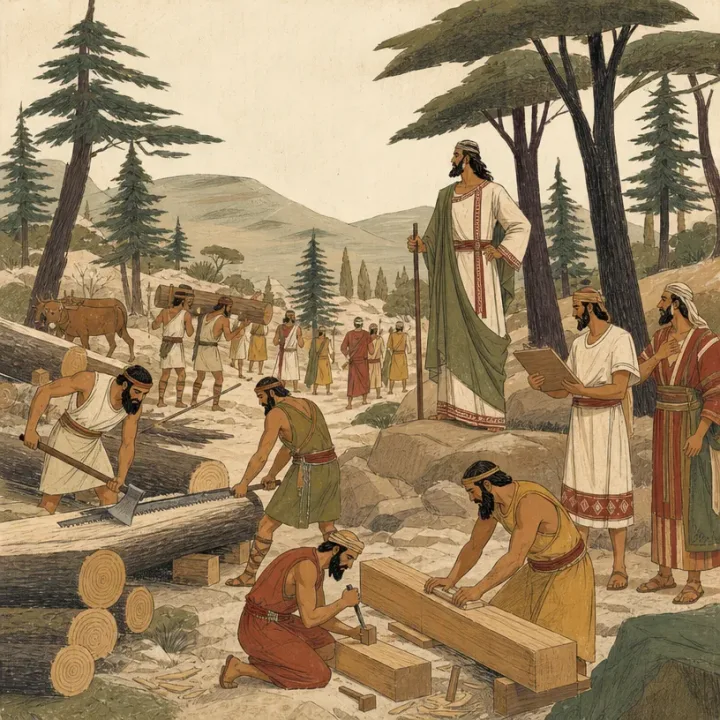
Lebanon is a mountainous region located north of Israel, known for its majestic cedar trees and natural beauty. It is mentioned numerous times throughout the Old Testament. The cedars of Lebanon were highly prized for their quality and were used in the construction of the Temple and other important buildings (1Ki.5.6, 9, 14; 2Ch.2.8, 16; Ezra 3:7). Lebanon is often used as a symbol of strength, prosperity, and beauty (Psalm 72:16; 92:12; Sng.4.11, 15; 5:15). It is also mentioned in the context of God's power and judgment (Psalm 29:5, 6; Isaiah 2:13; 10:34; Jeremiah 22:6, 23; Habakkuk 2:17). Lebanon is described as part of the Promised Land (Deu.1.7; 11:24; Joshua 1:4) and was a region where some Canaanite inhabitants remained (Judges 3:3). The beauty and majesty of Lebanon are used to illustrate the glory and splendor of the future kingdom of God (Isaiah 35:2; 60:13; Hosea 14:5-7).
Relations
Direct connections
Every entity the graph places in a stated relation with this one, grouped by the kind of link. Each relation is authored once and its inverse derived, so both ends always agree. Rows marked “registry” come from the identity spine rather than from a verse, and a row marked “which bearer is the source’s decision” is one where the name could have meant more than one person. The last group is not a relation at all — it counts the events two entities stand in together.
Read it
Where to read it
Every verse of the text carried here that names this entity — 56, across 16 books. The name is written 63 times in them.
Onward
Where this page goes
Not the direct relations above — these are one hop further out, ranked so that a rare shared connection outweighs a common one. Descriptions by STEPBible TIPNR.
Where they appear
What happened here
Atlas's reading of each chapter this place appears in, in canonical order. One line per chapter, and each leads to the whole of it.
- Joshua 1Lebanon marks the northern reach of the territory described to Joshua.
- 1 Kings 5Lebanon supplied the timber and received the rotating labor force sent to cut it.
- 2 Chronicles 2Lebanon supplied the cedar, cypress, and algum logs cut by Hiram's servants.
- Psalms 29Lebanon is shattered by the LORD's voice and made to skip like a calf.
- Psalms 72Lebanon supplies the forest likeness for the flourishing fruit trees.
- Psalms 104Lebanon is named among the trees of the LORD, the cedars He planted.
- Song of Songs 3Lebanon supplied the timber from which Solomon’s carriage was made.
- Song of Songs 4Lebanon is named as the place from which the bride is called down and as the source of a well of fresh water.
13 more chapters, from Song of Songs 5 to Zechariah 11
- Song of Songs 5Lebanon lends its majestic cedars to the beloved's appearance.
- Song of Songs 7Lebanon becomes a tower facing toward Damascus in the beloved’s face.
- Isaiah 14Lebanon’s cypresses and cedars exult when the woodcutters no longer come against them.
- Isaiah 29Lebanon is promised a swift transformation from forest to orchard.
- Isaiah 33Lebanon is ashamed and decayed as the land mourns.
- Isaiah 40Lebanon was declared insufficient to provide the fuel and animals for the proposed burnt offering.
- Isaiah 60Lebanon sends cypress, elm, and boxwood to adorn the sanctuary.
- Ezekiel 27Lebanon supplied the cedar used for Tyre’s mast.
- Ezekiel 31Lebanon was made to mourn when the great cedar was brought down.
- Hosea 14Lebanon supplies the cedars and the wine in Israel’s renewed splendour.
- Habakkuk 2Lebanon was named among the places overwhelmed by violence and destruction.
- Zechariah 10Lebanon receives the returning people until no more room is found for them.
- Zechariah 11Lebanon is called to open its doors while fire consumes its cedars.
Sources