
2 others in the registry answer to the name Mizpah. Every Mizpah in the Bible
place · also Mizpeh · Ramah · Ramathaim-zophim · Arimathea
Mizpah
מִצְפָּהἈριμαθαία
Mizpah (Mizpeh, Ramah, Ramathaim-zophim, Arimathea), a city in Benjamin where the Israelites gathered for judgment and prayer (Judges 20:1, 3; 21:1, 5, 8; 1Sa.7.5-7, 11-12, 16; 10:17), and the hometown of Samuel (1Sa.1.19; 2:11; 7:17; 8:4; 15:34; 16:13; 19:18-23; 20:1; 25:1; 28:3) and Joseph of Arimathea (Matthew 27:57; Mrk.15.43; Luke 23:50-51; Jhn.19.38).
- verses
- 50
- first named
- Joshua 18:26
- last named
- John 19:38
- feature
- settlement
- coordinates
- 32.03°N · 35.02°E
Rantis (OpenBible)
Scholarship offers 12 identifications for this place. The leading one is shown; the others are recorded in the gazetteer.
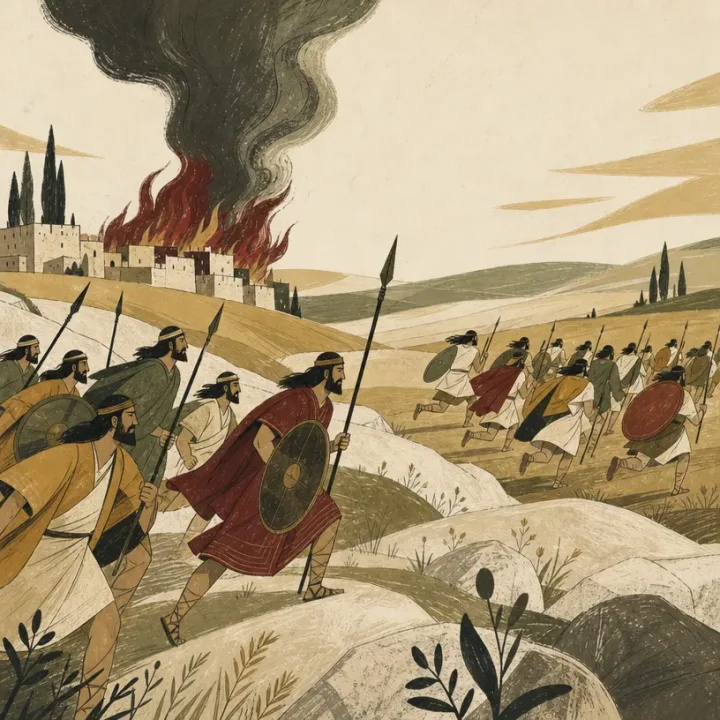
Description
Mizpah in the text
Mizpah, also known as Mizpeh, Ramah, Ramathaim-zophim, or Arimathea, was a city located in the tribal territory of Benjamin, near the border with Ephraim. It was an important religious and political center during the period of the judges and the early monarchy.
During the time of the judges, the Israelites gathered at Mizpah to address the crisis involving the tribe of Benjamin and the concubine at Gibeah (Judges 20:1, 3; 21:1, 5, 8). Later, the prophet Samuel summoned the people to Mizpah for prayer, repentance, and deliverance from the Philistines (1Sa.7.5-7, 11-12, 16). Samuel also gathered the Israelites at Mizpah to appoint Saul as their first king (1Sa.10.17).
Mizpah was the hometown and burial place of Samuel (1Sa.1.19; 2:11; 7:17; 8:4; 15:34; 16:13; 19:18-23; 20:1; 25:1; 28:3). It was also the city of Joseph of Arimathea, the wealthy disciple who provided the tomb for Jesus' burial (Matthew 27:57; Mrk.15.43; Luke 23:50-51; Jhn.19.38).
During the divided monarchy, King Asa of Judah fortified Mizpah using materials from the dismantled fortifications of Ramah (1Ki.15.22; 2Ch.16.6). After the Babylonian destruction of Jerusalem, Mizpah served as the administrative center for the remnant of Judah under Gedaliah (2Ki.25.23, 25; Jeremiah 40:6, 8, 10, 12-13, 15; 41:1, 3, 6, 10, 14, 16).
Relations
Direct connections
Every entity the graph places in a stated relation with this one, grouped by the kind of link. Each relation is authored once and its inverse derived, so both ends always agree. Rows marked “registry” come from the identity spine rather than from a verse, and a row marked “which bearer is the source’s decision” is one where the name could have meant more than one person. The last group is not a relation at all — it counts the events two entities stand in together.
Contains
Site of
- Gathering Israel1 Samuel 7:61 Samuel 7:7
- Ishmael and Ten Men’s killing of Gedaliah, Jews With Gedaliah, and Chaldean SoldiersJeremiah 41:3
- Ishmael’s captivity of Remnant People Of MizpahJeremiah 41:14
- Israel, All The People, and All Men Of Israel’s assemblyJudges 20:1
- Israel’s oathJudges 21:1
- Johanan’s speakingJeremiah 40:15
- Samuel’s judging of Israel1 Samuel 7:61 Samuel 7:16
Stands in the same events as
- Gedaliah10 events
- Ishmael10 events
- Samuel9 events
- Israel6 events
- Saul4 events
- Johanan4 events
- Naioth4 events
- David3 events
- Asa2 events
- Geba2 events
- Hannah2 events
- Elkanah2 events
and 14 more, ordered by how many events they share.
Read it
Where to read it
Every verse of the text carried here that names this entity — 50, across 12 books. The name is written 55 times in them.
Onward
Where this page goes
Not the direct relations above — these are one hop further out, ranked so that a rare shared connection outweighs a common one. Descriptions by STEPBible TIPNR.
Where they appear
What happened here
Atlas's reading of each chapter this place appears in, in canonical order. One line per chapter, and each leads to the whole of it.
- Judges 20Mizpah hosted Israel’s great assembly before the LORD.
- Judges 21Mizpah was where Israel assembled and swore its two troublesome oaths.
- 1 Samuel 7Mizpah hosted Israel’s gathering, confession, judgment, and the beginning of its pursuit of the Philistines.
- Jeremiah 41Mizpah held Gedaliah’s meal, his murder, the slaughter of the mourning men, and the seizure of its remnant.
Sources