
One other person, place or group in the registry answers to the name Gibeah. Every Gibeah in the Bible
place · also Gibeath · Gibeathite
Gibeah
גִּבְעָה
- verses
- 45
- first named
- Joshua 18:28
- last named
- Hosea 10:9
- feature
- hill
- coordinates
- 31.82°N · 35.23°E
Tel el Ful (OpenBible)
Scholarship offers 8 identifications for this place. The leading one is shown; the others are recorded in the gazetteer.
Description
Gibeah in the text
Gibeah was a city located in the territory of Benjamin, often associated with King Saul and the infamous atrocities that occurred there during the period of the judges. It was the hometown and burial place of Eleazar, the son of Aaron (Joshua 24:33). Gibeah is infamously known for the horrific incident involving the concubine of a Levite, which led to a civil war between the Benjamites and the other tribes of Israel (Judges 19-20). The city was also the birthplace and residence of Saul, the first king of Israel (1Sa.10.26; 15:34). Saul and his son Jonathan used Gibeah as a base of operations during their battles against the Philistines (1Sa.13.2, 15; 14:2, 16). The city is mentioned in the context of David's flight from Saul (1Sa.22.6; 23:19; 26:1) and in the account of the hanging of Saul's descendants (2Sa.21.6). Gibeah is also listed among the cities of Benjamin (Joshua 18:28; 1Ch.12.3) and is mentioned in prophetic passages (Isaiah 10:29; Hosea 5:8; 9:9; 10:9). The atrocities committed at Gibeah became a byword for the moral decay and lawlessness of the time, serving as a warning and a call to repentance for future generations.
Relations
Direct connections
Every entity the graph places in a stated relation with this one, grouped by the kind of link. Each relation is authored once and its inverse derived, so both ends always agree. Rows marked “registry” come from the identity spine rather than from a verse, and a row marked “which bearer is the source’s decision” is one where the name could have meant more than one person. The last group is not a relation at all — it counts the events two entities stand in together.
Read it
Where to read it
Every verse of the text carried here that names this entity — 45, across 7 books. The name is written 46 times in them.
Onward
Where this page goes
Not the direct relations above — these are one hop further out, ranked so that a rare shared connection outweighs a common one. Descriptions by STEPBible TIPNR.
Where they appear
What happened here
Atlas's reading of each chapter this place appears in, in canonical order. One line per chapter, and each leads to the whole of it.
- Judges 19Gibeah is reached at sunset, offers no lodging in its square, and becomes the scene of the night’s outrage.
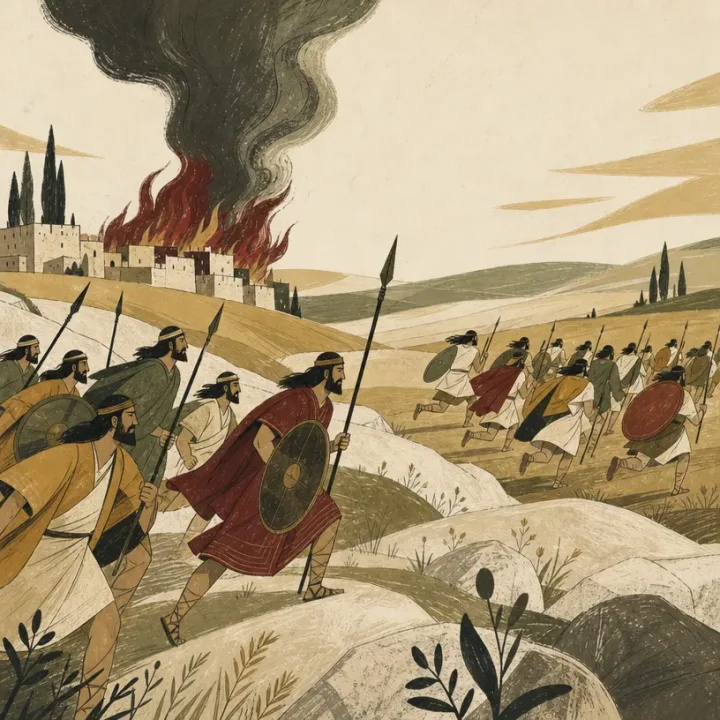
- Judges 20Gibeah received the first attacks, drew Israel into its battle, was captured by the ambush, and was burned.
- 1 Samuel 10Gibeah receives Saul as his home, with men of valor joining him there.
- 1 Samuel 11Gibeah heard the messengers’ report, and its people wept aloud until Saul came from the field.
- 1 Samuel 13Gibeah held Jonathan’s thousand men and later received Samuel after he left Gilgal.
- 1 Samuel 14Gibeah’s watchmen saw the Philistine troops melting away and scattering.
- 1 Samuel 26Gibeah was where the Ziphites came to Saul with news of David’s hiding place.
- Isaiah 10Gibeah flees as the advancing Assyrian force passes nearby.
Sources