
One other person, place or group in the registry answers to the name Mordecai. Every Mordecai in the Bible
person
Mordecai
מׇרְדֳּכַי
- verses
- 50
- first named
- Esther 2:5
- last named
- Esther 10:3
- period
- Exile and Return
- tribe
- Judah
Description
Who was Mordecai?
Mordecai, a prominent figure in the book of Esther, was a Jewish man living in the Persian capital of Susa during the reign of King Ahasuerus (Xerxes I). He was the son of Jair, from the tribe of Benjamin, and had been taken into exile from Jerusalem by Nebuchadnezzar, the king of Babylon (Est.2.5-6).
Mordecai is best known for his role as the cousin and guardian of Esther, who became queen of Persia. When Esther's parents died, Mordecai took her as his own daughter and raised her (Est.2.7). He later advised her to keep her Jewish identity secret when she was taken into the king's harem (Est.2.10).
Mordecai's loyalty to the king was demonstrated when he uncovered a plot by two of the king's eunuchs to assassinate Ahasuerus. He reported the conspiracy, and the eunuchs were hanged (Est.2.21-23).
However, Mordecai's refusal to bow down to Haman, a high-ranking official in the Persian court, led to a crisis for the Jewish people. Haman, enraged by Mordecai's defiance, plotted to destroy all the Jews in the empire (Est.3.5-6). Mordecai then urged Esther to intervene on behalf of her people, even at the risk of her own life (Est.4.13-14).
Through Esther's courage and Mordecai's guidance, Haman's plot was exposed, and the king issued a decree allowing the Jews to defend themselves. Haman was hanged on the gallows he had prepared for Mordecai (Est.7.9-10).
After this victory, Mordecai was elevated to a high position in the Persian court, second only to the king (Est.10.3). He used his influence to promote the welfare of the Jewish people and institute the festival of Purim to commemorate their deliverance (Est.9.20-32).
Throughout the book of Esther, Mordecai is portrayed as a wise, courageous, and faithful leader who risked his own life to protect his people and remained committed to his Jewish identity in the face of adversity.
Relations
Direct connections
Every entity the graph places in a stated relation with this one, grouped by the kind of link. Each relation is authored once and its inverse derived, so both ends always agree. Rows marked “registry” come from the identity spine rather than from a verse, and a row marked “which bearer is the source’s decision” is one where the name could have meant more than one person. The last group is not a relation at all — it counts the events two entities stand in together.
The 10 best-attested of 21 are drawn. All 21 are listed below.
Child of
- JairregistryEsther 2:5
Took part in
- Decree WritingEsther 8:8
- Esther’s instructionEsther 4:10
- Haman’s building of GallowsEsther 7:9Esther 7:10
- King Attendants and Haman’s arraying of Man and MordecaiEsther 6:11
- King Attendants and Haman’s parading of Man and MordecaiEsther 6:11
- King Attendants and Haman’s proclamationEsther 6:11
- Mordecai’s report of EstherEsther 2:22
- Mordecai’s sending of Mordecai LettersEsther 9:20Esther 9:23Esther 9:30
Stands in the same events as
- Esther17 events
- Haman13 events
- Judah5 events
- Ahasuerus5 events
- Hathach5 events
- Provinces2 events
- Jerusalem1 event
- Sitting1 event
- Clothing1 event
- Horse1 event
- Nebuchadnezzar1 event
- Power1 event
and 14 more, ordered by how many events they share.
Places
Where this happens
The places the claims about this person reach, drawn where the gazetteer locates them. A point is where a row puts them and never where tradition does; no line joins two points, because the rows state where and not in what order.
Read it
Where to read it
Every verse of the text carried here that names this entity — 50, across 1 book. The name is written 58 times in them.
Onward
Where this page goes
Not the direct relations above — these are one hop further out, ranked so that a rare shared connection outweighs a common one. Descriptions by STEPBible TIPNR.
Where they appear
Chapter by chapter
Atlas's reading of each chapter this person appears in, in canonical order. One line per chapter, and each leads to the whole of it.
- Esther 2Mordecai raised Esther, watched for news of her, kept her identity concealed, and reported the plot at the king’s gate.
- Esther 3Mordecai refused to bow to Haman, and his refusal drew the Jews into Haman’s fury.
- Esther 4Mordecai mourns at the king’s gate, sends Esther the decree, and urges her to plead for her people.
- Esther 5Mordecai sat at the king’s gate and neither rose nor trembled when Haman appeared.
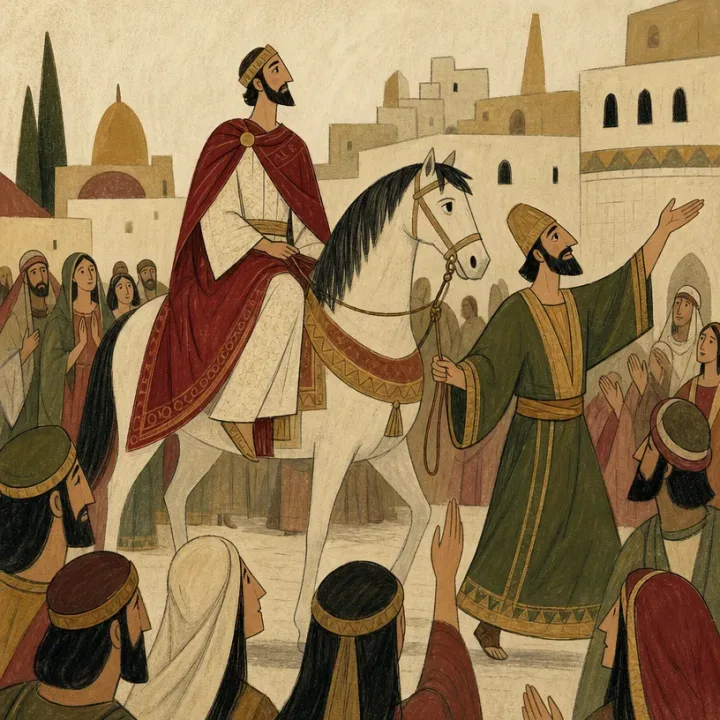
- Esther 6Mordecai was arrayed in the king’s robe, paraded through the city square, and then returned to the king’s gate.
- Esther 7Mordecai is named as the man whose report saved the king and for whom Haman built the gallows.
- Esther 8Mordecai received the king’s signet ring, composed the new orders, and sent them racing through the provinces.
- Esther 9Mordecai grew powerful, recorded the events, and sent letters establishing the days of Purim.
1 more chapter, from Esther 10 to Esther 10
Sources