
person
Haman
הָמָן
- verses
- 45
- first named
- Esther 3:1
- last named
- Esther 9:25
- period
- Exile and Return
- tribe
- Persian
Description
Who was Haman?
Haman is the primary antagonist in the book of Esther. He was an Agagite, a descendant of the Amalekite kings, and a high-ranking official in the Persian Empire during the reign of King Ahasuerus (Xerxes I). Haman was promoted to a position of authority and commanded all the royal officials to bow down to him (Est.3.1-2). However, Mordecai, a Jew, refused to bow to Haman (Est.3.2-4). Enraged, Haman plotted to destroy not only Mordecai but all the Jews in the empire (Est.3.5-6). He convinced the king to issue a decree ordering the extermination of the Jews (Est.3.8-15). Haman also had a gallows built to hang Mordecai (Est.5.14). However, Haman's plans were thwarted by Queen Esther, who revealed her Jewish identity to the king and exposed Haman's plot (Est.7.1-6). The king ordered Haman to be hanged on the very gallows he had prepared for Mordecai (Est.7.7-10). Haman's ten sons were also executed (Est.9.10-14). The king then issued a new decree, allowing the Jews to defend themselves against their enemies (Est.8.1-14). Haman's story serves as a powerful example of how God can use individuals to protect His people and bring about justice, even in the face of great adversity.
Relations
Direct connections
Every entity the graph places in a stated relation with this one, grouped by the kind of link. Each relation is authored once and its inverse derived, so both ends always agree. Rows marked “registry” come from the identity spine rather than from a verse, and a row marked “which bearer is the source’s decision” is one where the name could have meant more than one person. The last group is not a relation at all — it counts the events two entities stand in together.
The 10 best-attested of 32 are drawn. All 32 are listed below.
Associated with
Child of
- HammedatharegistryEsther 3:10Esther 3:1Esther 8:5 +2
Father of
Spouse of
- Zereshregistry, no verse
Took part in
- Ahasuerus and Haman’s dining of WineEsther 7:1Esther 7:2
- Haman’s building of GallowsEsther 7:9Esther 7:10
- Haman’s entryEsther 6:4Esther 6:6
- Haman’s plot of JudahEsther 9:24Esther 9:25
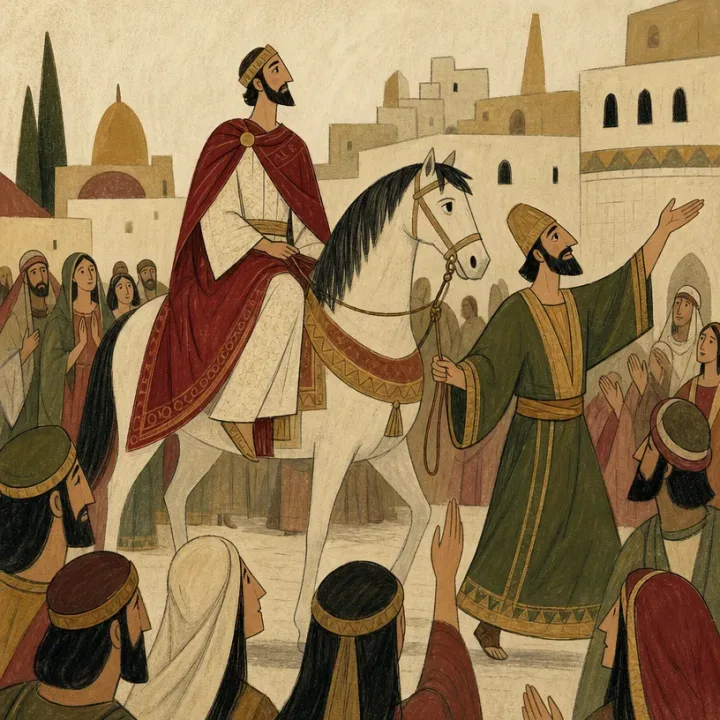
- Haman’s taking of Royal Robe and Royal HorseEsther 6:10Esther 6:11
- Judah’s hanging of Hamans Ten Sons and HamanEsther 9:25
- King Attendants and Haman’s arraying of Man and MordecaiEsther 6:11
- King Attendants and Haman’s parading of Man and MordecaiEsther 6:11
- King Attendants and Haman’s proclamationEsther 6:11
Stands in the same events as
- Mordecai13 events
- Ahasuerus13 events
- Judah9 events
- Esther4 events
- Zeresh4 events
- Purim2 events
- People1 event
- Coming1 event
- Standing1 event
- Destruction1 event
- Servant1 event
- Wine1 event
and 5 more, ordered by how many events they share.
Places
Where this happens
A person is placed by the events they take part in, and an event has to clear three things to place them: it must say where it happened, that place must be one the gazetteer can put a coordinate on, and the verse must report it rather than foretell, command or ask it. Nothing anchored here clears all three. Where the text names a setting no gazetteer surveys — a vineyard, a palace, a plot of ground — it is left off rather than guessed at; where a place is named only in a prophecy, the map does not draw what was said to be coming as though it had happened; and a place reached only through a relation is not inherited, because standing beside somebody is not being somewhere.
No verse Atlas has read as a report puts this person anywhere.
Not read yet
Read it
Where to read it
Every verse of the text carried here that names this entity — 45, across 1 book. The name is written 53 times in them.
Onward
Where this page goes
Not the direct relations above — these are one hop further out, ranked so that a rare shared connection outweighs a common one. Descriptions by STEPBible TIPNR.
Where they appear
Chapter by chapter
Atlas's reading of each chapter this person appears in, in canonical order. One line per chapter, and each leads to the whole of it.
- Esther 3Haman rose above the princes, demanded homage, and turned Mordecai’s refusal into a decree against every Jew in the kingdom.
- Esther 4Haman promised money for the destruction of the Jews, the exact amount being reported but not given.
- Esther 5Haman went from a private banquet to a public rage, then had a fifty-cubit gallows constructed for Mordecai.
- Esther 6Haman entered the court to seek Mordecai’s death, proposed an extravagant royal honour, and was ordered to perform it for Mordecai himself.
- Esther 7Haman stands in terror, begs Esther for his life, and is hanged on the gallows he prepared for Mordecai.
- Esther 8Haman’s scheme remained sealed beyond recall, though his estate and signet ring passed into Esther’s and Mordecai’s hands.
- Esther 9Haman was named as the enemy whose plot returned upon his own head and upon the heads of his sons.
Sources